Method
The key observation of our work is that the limitation of CFG in controlling editing strength arises from the dominance of the unconditional prediction at low guidance scales. In instruction-based editing settings, the unconditional prediction typically corresponds to an arbitrary manipulation of the input rather than faithful reconstruction. Consequently, when the guidance scale is varied, low guidance values do not induce small semantic changes around the input.
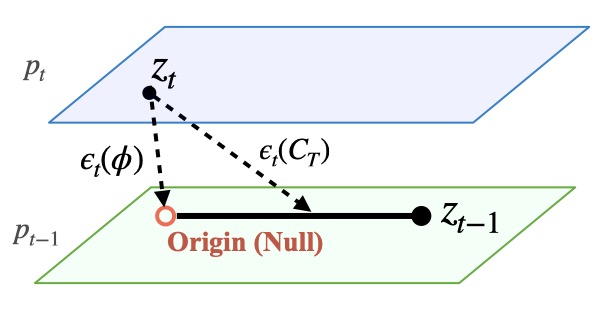
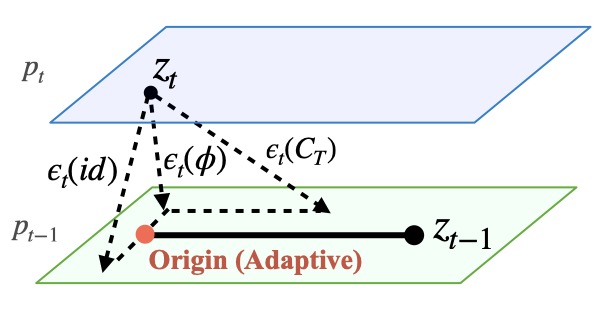
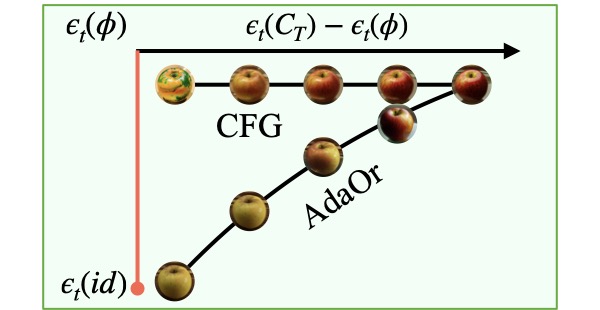
To enable smooth control over edit strength, we introduce an identity instruction — an instruction that corresponds to the identity manipulation, reproducing the input content without any semantic modification. Building on this, we introduce a guidance mechanism where the term that dominates the prediction at low scales (i.e., the origin) is adjusted according to the desired edit strength. Specifically, we interpolate between the identity prediction and the standard unconditional prediction.
By assigning greater weight to the identity term at lower edit strengths and transitioning to the standard term at higher strengths, our method enables smooth, continuous control over manipulation intensity without requiring per-edit optimization or specialized datasets.